Sunday, March 4, 2012

Life goes on...


My parents are in Florida this week, and I sent with them a rock from our house here in Colorado to be placed on my grandparents' grave. It's a grave I may never visit again, now that my parents have moved to Colorado.

There are lots of supposed reasons that Jews put stones on the gravemarkers of our dead. I've heard these:
  • It signifies that this person is honored enough to have visitors -- the deceased has not been forgotten.
  • It is reminiscent of biblical times, when graves were marked with a pile of stones.
  • Stones were originally used to hold down notes that visitors wold place on graves, lest they blow away.
  • The stone opens a channel of communication between the visitor and the dead.
I've always thought the stone on the grave was a nice gesture, though clearly for the living. My grandparents graves in Florida have a flat marker, and often the groundskeepers just push the rocks to the side, where they become part of the sandy soil, framing its edge with the evidence of years' worth of visits. Like the tree in the picture, they have become part of the graves' permanent landscape and will remain, even when the visits stop.


Wednesday, February 29, 2012

Kabbalah -- Just like I expected and not like I expected at all...

The Sages state that it is "only at the age of 40 that the disciple is fit to understand properly the thought of his master," for "40 years is the age of wisdom." That is why, in general, the kabbalists prefer to "transmit" their teaching to disciples who are at least 40 years old. In their opinion, at that age the human soul becomes spiritually mature. The Hebrew word 'neshamah,' soul, confirms this; the letters which compose it also make up the words 'mem shanah,' 40 years.


For many years, I've had a non-interest in the study of Kabbalah. I'm not very into mysticism, and if you've read this blog before, you know I'm a skeptic. I don't believe in the supernatural, and I'm a follower of Dawkins, Hitchens and Harris. Theodicy -- why bad things happen to good people -- has always been a stumbling block for me and the answers religion offers just don't satisfy. 


I've also, for many years, used the convenient excuse that the study of kabbalah is restricted to those 40 and over. Yeah. That excuse fell by the wayside recently. 40 I now is.


So when our rabbi announced that he was offering a new class on kabbalah, I decided to sign up. I love studying with our rabbi, and I get out of the house every Tuesday night to spend time with other adults, learning something. Besdies, with a title like: Kabbalah: Hidden Truths: The Earth-Shattering Kabbalah of R'Chayyim Vital and R'Nachman of Bratslav, how could I resist?


It's Just Like I Expected


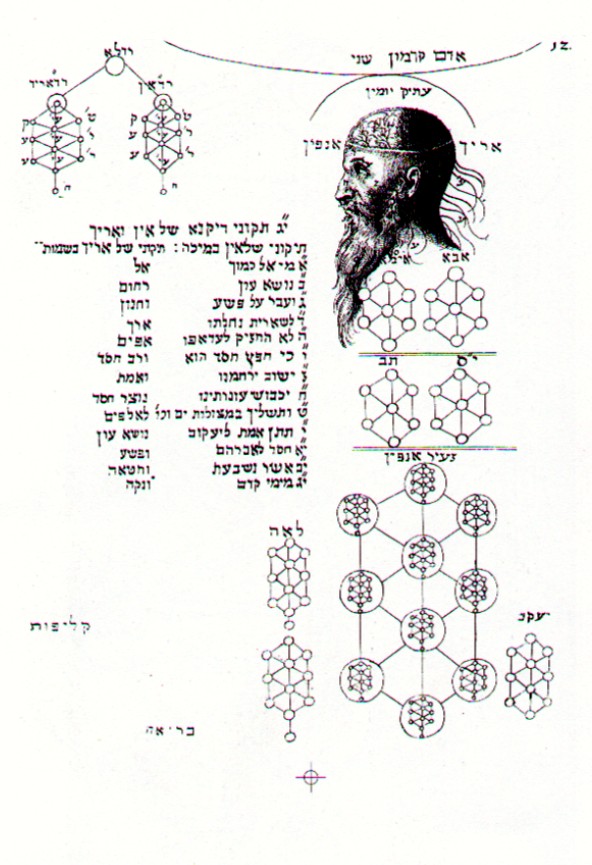
We spent the evening studying the personal journal of Chayyim Vital, a kabbalist and student of Isaac Luria from the late 16th century (WIki here:) and reviewing and dissecting the various levels of Souls, Mystical Worlds, Sefirot, Partzufim, etc. The graphic below makes it entirely clear.


All the four worlds are contained in each of the five levels of the soul, and each of the partzufim are contained in each of the four worlds which are contained in each of the the five levels of the soul. To move up in soul levels from lowest to highest, you have to rectify/integrate all of the levels of all of the other parts. Again, a simple visual explanation:


Moving up each of these levels moves you closer to The One (God), until you are about as close to God as a human being can get. 


Fellow classmate Peter said it was like becoming a Jedi. I kept think of Pokemon (thanks, 10-year-old son) and how they evolve from one stage to the next. Also Angry Birds, where to progress to the next level you have to complete all the puzzles of the previous level. In the Soul Game, however, you'd have to complete all the levels with 5 stars, no exceptions. And if you fail a level, you may have to go back to the beginning. With reincarnation -- yup, Jewish reincarnation -- this becomes a long, long process.


For those like me who are pretty darn sure souls don't even exist, these mental gymnastics about it seem like a waste. Reading the journal of Vital is like reading the scribblings of a man suffering from delusions of grandeur. Everyone he meets is a fortune teller who tells him how great he is -- the greatest in his generation. His belief system -- all of this soul-raising -- must feed on the self-centerdness. 


Why, asks the woman of logic and science, do you all have to make things so complicated?


It's Not Like I Expected


Sometimes I forget the benefits of being an adult student in a completely optional, taking-it-for-fun class. While I am there to learn, I am also there to learn on my own terms and take from the material what I want -- and that might be very different from what's being offered.


As we discussed last night, there is no such thing as a direct transmission of knowledge or ideas from teacher to student. We all have our own perspective and our own interpretive frame from which we cannot escape. What Isaac Luria transmitted to Chayyim Vital; what Rabbi Ben teaches me; perhaps even what God transmitted to Moses... all of the students put their own spin on things. 


Vital interprets Luria
Moses interprets God (oooh, that's a whole other blog post there...)
Susan interprets Rabbi Ben, who interprets Vital, who is interpreting Luria, etc.


I get my own spin, too.

  • As a study of Jewish history, kabbalah certainly offers some of the more interesting characters. Vital is annoying, but fascinating, and how many other journals from the late 1500s have I read? About zero.
  • I'm fascinated by the ways people rationalize their supernatural beliefs, and these guys are experts. Why is casting magic spells and making amulets prohibited in Vital's time? Because we don't have the ashes of the red heifer, of course. Sorry.
  • Even something like kabbalah can be dangerous. I was disturbed by the connection made between ailments of the body and the mystical belief that it's connected, somehow, to the way your soul-work is going, etc. What a terrible burden to put onto people for their physical ailments. You're in pain? You must not be doing X, Y, Z in the spiritual realm correctly. Pshah.
  • The underlying message -- when you strip away all of the religious layers, may still be relevant. I'm working on this one, but a little self-awareness can be healthy, and kabbalah seems to be saying the same thing as Shrek -- we're like onions. Or, if you prefer Donkey, like parfaits. We all have layers. Call them soul layers if you're religious, or psychological layers if you're not, but we've all got them. Why not explore them?


Besides, how could I not love a class where Jedis, Stargate, holograms, holodecks, mind-enhancing drugs and pissing in the temple courtyard all came up for discussion. 


Tuesday, February 21, 2012

Good-bye, Francis


Our veterinarian has played the cruelest trick on us.

This morning we were so worried about our dear feline, Frankie, that we called the vet who then told us to bring him in immediately. He hadn't eaten for days, he had stopped grooming himself, and he had lost a significant amount of weight. He looked uncomfortable in his own body; his back legs were bent awkwardly when he stood, and he had trouble getting up and down from our bed, his home base.

Evan phoned the vet, who said to bring him in right away. He was down to 9 pounds, from his most robust 16, and all of his blood test results were off the charts...on the low end. He was extremely anemic. There were possible underlying reasons, the vet said, but it wold cost hundreds of dollars to find out what they were, and since Frankie is 19, there didn't seem to be much point. He was giving us the signal -- I'm done.

Evan and I made the decision, together, to bring him home for one more night with the family and then bring him back to the vet tomorrow for euthanization. (I wrote that sentence five other ways before I decided to  just say the truth.) It felt like the right decision for the right reasons.

Before Frankie came home, the vet gave him IV fluids, a pain killer, and an appetite stimulant, which, as she said, would "perk him up a little bit." And it has worked. Frankie does seem to have a little more energy. The decision I was so sure about last night and this morning is tearing me up inside now. 

We've been here before. The same exact scenario happened with our dog Daisy. We went to the vet with an animal we were ready to let go and returned home with one who was, temporarily and deceivingly, better.

Frankie is not better. He will not get younger. He will not magically being taking care of himself again. He will not regain his appetite (even tonight he turned up his nose at food and his most favorite treat, milk.) He will not be healed, and, without significant medical intervention, and maybe even with it, he will not live more than a few more months.

I know all of these things, and I want to believe none of them.

When we bring a pet into our lives, we know it will not be forever. Their life spans are but a fraction of ours, and though we may trick ourselves into believing otherwise, we will outlive almost all of them. As their guardians and custodians, we have the biggest rewards, responsibilities and burdens. The have placed in us a sacred trust, to be, in the truest sense, their guardians. 

So tomorrow morning we will take our beloved Francis "Frankie Blue Eyes" to the vet and she will inject him with a fatal dose of something or other. He will die, and I will wonder for a very long time whether we made the right decision. 


Saturday, February 18, 2012

Controversy: It is natural to believe in God, so more intelligent individuals are more likely to be atheists.


Humans are designed by evolution to believe in GodPublished on April 11, 2010 by Satoshi Kanazawa in The Scientific Fundamentalist

Why Atheists Are More Intelligent Than the Religious

Friday, February 10, 2012

Rights are not a matter for public referendum. Ever


"Dear God, we should not put civil rights issues to a popular vote to be subject to the sentiments and passions of the day. No minority should have their civil rights subject to the passions and sentiments of the majority.”


I can't think of a single one. Can you?